The route
Trwyn Llwyd is a vowel-free gabbro sea cliff in the esoteric Welsh climbing area of North Pembroke. Twinkler is a two pitch HVS (~YDS 5.9) that wanders across the cliff finding the easiest line between much harder routes. In the 1990s it was graded VS.
The context
For all sorts of reasons best left undocumented, 1997 was a chaotic year for me. The frequency of my weekend climbing was about the same as usual but I was very distracted and did little of note. In grade terms, the highlight was a trip to El Chorro in Spain in January where I redpointed a 7b fairly easily. One unusual feature of the year was that Dan (mentioned twice before in this blog and likely to recurr again) rented a room from me in the north London flat that I had just bought. Inevitably this meant that we climbed together more often.
In May we spent a long weekend in the North Pembroke. I believe the motivation was that a new guidebook had just come out. Photos show that we dossed two nights in a pub car park; a typical strategy in those days. On Saturday and Sunday we visited four cliffs, roping up for several routes in the E1-E3 range, most of which seemed somewhat less worthwhile than the guidebook promised.
The ascent
On Monday, the diary notes that it was "scorchingly hot" and that we climbed unroped most of the day, mostly on very easy short pitches. To end the day Dan suggested a "convoy solo" of Twinkler. It had been several years since I had last soloed a multi-pitch and I remember feeling some concern. However VS was comfortably within my limit so objectively the risk was low. Dan soloed often at that time. I acquiesced.
Convoy soloing - two or more people climbing unroped on the same route at the same time - was something I had done a few times prior to this. Especially ten years before at Arapiles, when I and most of my regular partners were very young and foolish. Aside from moonlight idiocy on D Minor, mentioned here, I got notably scared onsighting the 100m slab classic Brolga unroped. Both I and my friend Pete found it much more delicate, insecure and irreversible than we had anticipated. A unique aspect of this dumb activity is the potential opportunity to be private witness to your partner's death (or vice-versa) as a section is tackled which the other has already completed. I still remember Pete and I's nervous banter, wide-eyes and various "what the fuck are we doing" philosophising on that ascent.
Twinkler lured us in gently with a traverse above the sea that was easy and unexposed. In fact, I recall absolute no issues with the route until the very end where a short overhanging crack connected a small ledge with the top of the cliff. Dan did this quickly as I waited on the ledge. As I followed, it dawned on me that the crack was awkward and would be a challenging down-climb. The final move was a pull over a bulge on to gently-sloping terrain. I recall some dependence on a shallow unsatisfactory hand jam. I paused and looked at Dan who I think mumbled something like "it is OK" but looked worried. I paused a while longer. It was a bad place to stop; fatiguing eventually. The fall would have been 30m or more toward the sea, possibly into water of uncertain depth, possibly on to boulders. I doubt more than a few seconds passed in total, but as the cliche goes: they were "long" seconds. Finally I pulled the move, there being no other options and of course it was fine.
Researching this blog post, I stumbled over notes on a 2017 ascent of Twinkler that may shed some light on why the route felt so marginal: "[pitch] 2 felt hard even for HVS 5a as per the 2013 guide to finish up the steep final crack though i might have done the finish to "Better Led than Dead" climbing up a steep crack above a small step down in the ramp, either way this was excellent and well protected but felt E1 5b."
Subsequent ascents
I have not been back to North Pembroke.
I have also not soloed anything substantial since 1997. Where we live now in Squamish, there is an abundance of solid moderate climbing, moments from our front door, that is very well-suited for unroped climbing. But I don't do it. I believe I could run many laps with the required focus but in time complacency would be inevitable. Best not to start.
A case in point: in September this year I slipped off the final 5.4 pitch of a ten pitch new route that I had helped establish a few months earlier and had already climbed five times. I was seconding with far too much slack in the system, so fell the length of the pitch to ledges, bruising a few ribs and opening a spectacular though unserious scalp wound. No big deal but it could have been much worse. If anyone had asked me in advance how many times I could climb that pitch without falling I would have estimated thousands, not five ...
Trwyn Llwyd is a vowel-free gabbro sea cliff in the esoteric Welsh climbing area of North Pembroke. Twinkler is a two pitch HVS (~YDS 5.9) that wanders across the cliff finding the easiest line between much harder routes. In the 1990s it was graded VS.
The context
For all sorts of reasons best left undocumented, 1997 was a chaotic year for me. The frequency of my weekend climbing was about the same as usual but I was very distracted and did little of note. In grade terms, the highlight was a trip to El Chorro in Spain in January where I redpointed a 7b fairly easily. One unusual feature of the year was that Dan (mentioned twice before in this blog and likely to recurr again) rented a room from me in the north London flat that I had just bought. Inevitably this meant that we climbed together more often.
In May we spent a long weekend in the North Pembroke. I believe the motivation was that a new guidebook had just come out. Photos show that we dossed two nights in a pub car park; a typical strategy in those days. On Saturday and Sunday we visited four cliffs, roping up for several routes in the E1-E3 range, most of which seemed somewhat less worthwhile than the guidebook promised.
 |
| (fresh) Airbnb - 90's style |
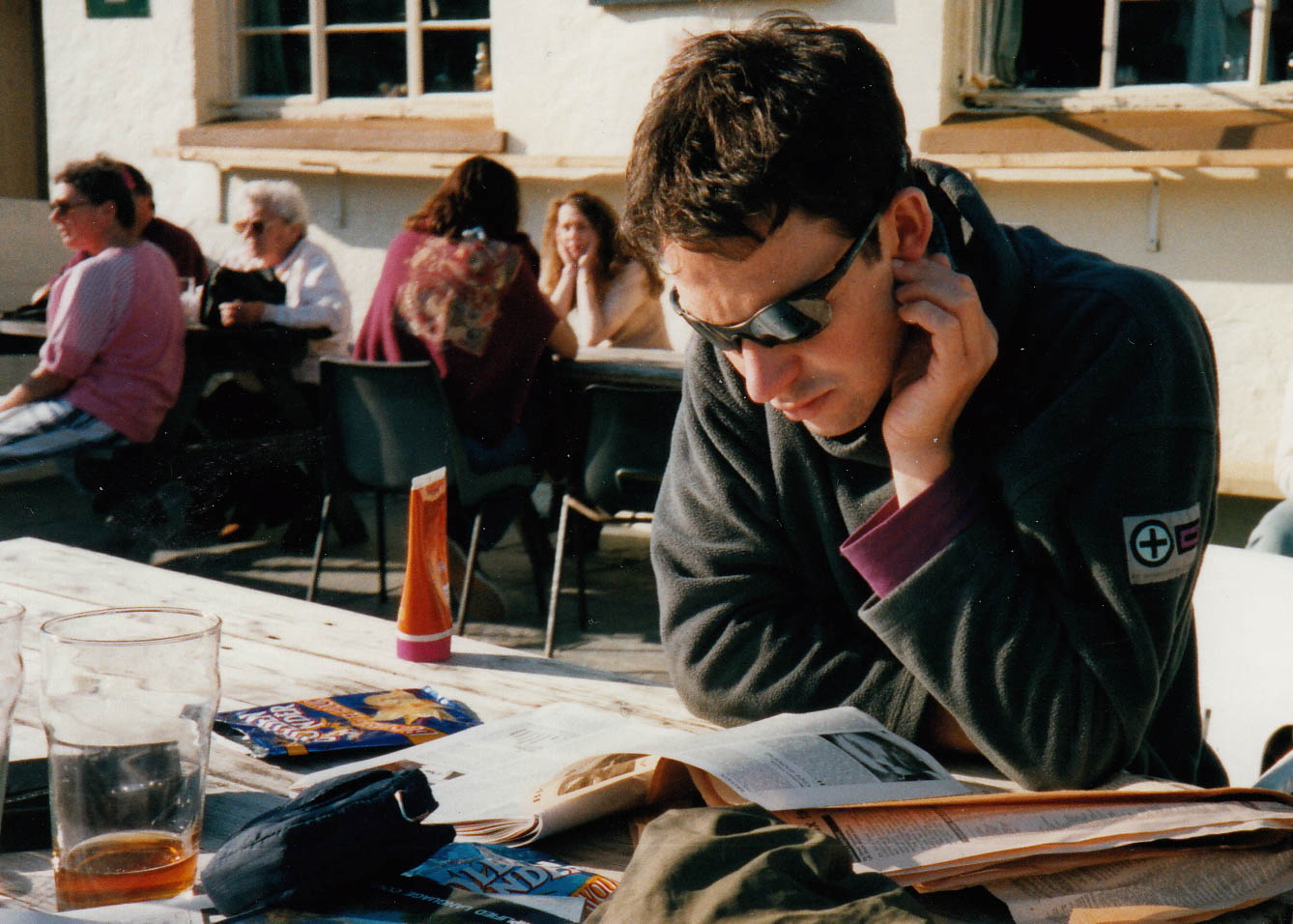 |
| The Economist and the Financial Times - essential accessories for the travelling Londoner |
On Monday, the diary notes that it was "scorchingly hot" and that we climbed unroped most of the day, mostly on very easy short pitches. To end the day Dan suggested a "convoy solo" of Twinkler. It had been several years since I had last soloed a multi-pitch and I remember feeling some concern. However VS was comfortably within my limit so objectively the risk was low. Dan soloed often at that time. I acquiesced.
Convoy soloing - two or more people climbing unroped on the same route at the same time - was something I had done a few times prior to this. Especially ten years before at Arapiles, when I and most of my regular partners were very young and foolish. Aside from moonlight idiocy on D Minor, mentioned here, I got notably scared onsighting the 100m slab classic Brolga unroped. Both I and my friend Pete found it much more delicate, insecure and irreversible than we had anticipated. A unique aspect of this dumb activity is the potential opportunity to be private witness to your partner's death (or vice-versa) as a section is tackled which the other has already completed. I still remember Pete and I's nervous banter, wide-eyes and various "what the fuck are we doing" philosophising on that ascent.
 |
| Dan starting Twinkler |
Researching this blog post, I stumbled over notes on a 2017 ascent of Twinkler that may shed some light on why the route felt so marginal: "[pitch] 2 felt hard even for HVS 5a as per the 2013 guide to finish up the steep final crack though i might have done the finish to "Better Led than Dead" climbing up a steep crack above a small step down in the ramp, either way this was excellent and well protected but felt E1 5b."
Subsequent ascents
I have not been back to North Pembroke.
I have also not soloed anything substantial since 1997. Where we live now in Squamish, there is an abundance of solid moderate climbing, moments from our front door, that is very well-suited for unroped climbing. But I don't do it. I believe I could run many laps with the required focus but in time complacency would be inevitable. Best not to start.
A case in point: in September this year I slipped off the final 5.4 pitch of a ten pitch new route that I had helped establish a few months earlier and had already climbed five times. I was seconding with far too much slack in the system, so fell the length of the pitch to ledges, bruising a few ribs and opening a spectacular though unserious scalp wound. No big deal but it could have been much worse. If anyone had asked me in advance how many times I could climb that pitch without falling I would have estimated thousands, not five ...


