A reminder:
what is the nostalgia project?
The route
Generation-X is a limestone deep water solo (DWS) route above the Indian Ocean, at Gen's Cave on the Musandam coast of Oman. The grade is around 7b+ (5.12c). Gen's Cave is mentioned in the Dibba Coast chapter of
UAE Rock Climbing (2009) and Generation-X described in
this update PDF published in 2011.
 |
| Gen's Cave, Musandam. Generation-X climbs from the sea, centre of the image |
 |
Neil Gresham researching Generation-X before making the first ascent, 2011
The eventual line was about one metre to the left |
The wild Indian Ocean coast of Musandam forms a continuous cliff line for an extraordinary length. A minimum estimate would 90km; being the straight-line distance from the sleepy UAE/ Omani port of Dibba up to the
geopolitical hotspot of the Strait of Hormuz, near Iran. However a close look at a map shows that the coast is a crazy fractal puzzle of inlets within coves within bays, and so is far longer. It would take a lifetime to explore thoroughly. Climbing is accessed by boat and almost always "descended" by jumping back to the sea. For perfection, a visit should be multi-day, using a traditional arabian dhow for sleeping and a smaller powerboat to support climbing. With luck, nights will include a
phosphorescence show and days include snorkelling amongst coral and seeing dolphins. It is a magical place.
 |
Classic Musandam DWS action #1: support boat and climber
Tim Emmett, first ascent of Free Diving, The Red Pillar, 2011 |
 |
Classic Musandam DWS action #2: support boat, snorkeller and climber
Matt Pfeiffer on Free Diving at The Red Pillar, 2011 |
 |
Classic Musandam DWS action #3: arabian dhow, incomparable scenery
(and Leo aged six, rowing the inflatable, 2006) |
 |
| Classic Musandam DWS action #4: playing with dolphins, 2011 |
 |
|
Sara O"Rourke styling the Barracuda Stack exit, 2011 |
 |
| Classic Musandam DWS action #6: drying chalk bags |
The context
I was very privileged to be one of the pioneers of DWS climbing on the Musandam coast and the main chronicler of that activity. Over seven years from 2006, I made numerous first ascents, checked out dozens of cliffs and documented over one hundred routes. More importantly it still conjures great intensity in my memory where other fragments from that period have begun to fade: brisk sea air; cliffs stretching to the horizon but revealing fresh geometries around every corner; fear of falling or jumping into the sea, and relief at surviving the same; rare but precious glimpses of a flow state in which increasing height above water became a perverse pleasure; salt water stinging abraded hands; elated sunburned friends; fishmarket odours at Dibba port; deep exhaustion ahead of long drives home.
Our first forays were a steep learning curve. Unexpected early lessons included not sharing boats with an expat rugby team (!) and not being afraid of large fish (after the first ascent of one stack I realised I was about to jump ten metres into a shoal of two meter long barracuda).
More generically, we learned to check for actual deep water under our prospective climbs; in some sheltered bays, coral reefs existed just under the low tide mark. Another key insight was not to swim to the cliffs and attempt to pull out of the water. The rock just under the high tide mark was usually razor sharp, with potential for Tarantino'esque injuries. It was almost always better to step off a boat. That in turn necessitated a boatman who understood what we were trying to achieve. On a few worrying occasions, the support boat would linger in the fall zone rather than reverse away to a safe distance.
Choppy seas also rendered boat-to-cliff manoeuvres more serious. We learned not to DWS in the winter, when the Indian Ocean typically had larger swells. Later we also learned not to DWS in the summer either despite the superficial attraction of being at sea during the hottest months - it was just far too humid. April and May is the best time.
Even more evolved beta included carrying a lightweight dry-bag up routes, to enclose shoes and chalk bag before jumping back to the water. Attempting "hard" routes where falls were likely required bringing multiple shoes (and chalk bags) to the cliffs so one had a reasonable chance of having a dry pair for the successful send.
 |
Me, The Original Route, Shark Bay, 2006., rediscovered in 2012
possibly the Musandam coast's first DWS first ascent? |
 |
Me and Mike O, exploring the Barracuda Stack, 2006
(The FA of the Pyramid in the background is in the blog here) |
Gen's Cave is named for Genevieve, an expat French climber whose birthday coincided with an early exploratory trip. I wasn't on that trip but did check the place out a couple of years later. The unusual feature of the cliff is a sea cave entrance just tall enough for small boats to enter, with a dank hollowed-out "room" behind. That experience is a highlight for tourist boats from Dibba or
Zighy Bay.
At the lip of the cave entrance is a good hold. In 2010, I figured out that it could be grabbed from a carefully-piloted boat at the right tide. This move leaves the climber dangling footless above the water but a swift campus move gains a jug rail and then a small ledge about seven metres above the sea. Above the ledge the rock arches outwards in an impressive roof feature for at least another ten metres. I remember making an uncommitted effort to make further progress and falling almost immediately. I forget whether others tried it but certainly no-one got higher.
 |
| Me playing on the start of what would become Generation-X, 2010 |
Around the same time, my guidebook to UAE climbing, printed at the end of 2009 and including a short chapter on Musandam DWS, had started to spark some interest overseas. One big surprise was an email from Seb Grieve, the Sheffield-based star of the influential 1990s climbing film,
Hard Grit. He and a group of friends had got in the habit of making regular expeditions to obscure climbing locations, and he was wondering whether Musandam should be their next destination.
We continued corresponding through the winter of 2010/11, eventually ending up with a plan for Seb and four friends - all at the intimidatingly-famous end of the climber spectrum - to spend a week on a dhow exploring the coast. (Hamad Sajwani, an Emirati climber, played a critical role in negotiating this with a Dibba boatman.) I offered to join as a guide and hoped to get other UAE-based climbers involved, but the cost and time commitment seemed prohibitive for them. At a late stage I remembered Read Macadam, a very strong Canadian climber living in Muscat, who could both represent expat climbers better than me and also spoke Arabic. To my relief, he signed up enthusiastically.
The trip ended up being very memorable for me and I think a good experience for all involved. I could write about it at great length but as that would be a little off-topic I have just posted a few photos below. (The
update PDF gives a good flavour of what was climbed.)
 |
| Collecting the Brit all-star crew from DXB: Neil, Tim, Mikey, Seb, Grant |
 |
| Same crew, paying homage to Damian's Boulders, Dibba |
 |
| Same crew plus Read - third from left - and our boatmen |
 |
| Same crew, technology break |
 |
| Some idiot in a kayak© unsure, possibly Neil G |
 |
| Same idiot, second ascent of One Liner, Big Wall Bay © unsure, possibly Neil G |
 |
| Mikey on Prohibition, Far North Bays |
 |
| Me and Mikey starting FA projects, Platform's Cove © unsure, possibly Neil G |
 |
Read, FA of Partheon Slots, 8a, 2011 © unsure, possibly Neil G
The hardest DWS route in the Middle East |
Though we travelled the length of the coast up to the Strait of Hormuz, the team found the best potential at Big Wall Bay, about half way up the coast, and at Gen's Cave. I showed the main cave project to Neil Gresham who worked on it for half a day or so, while the rest of the team put up some startingly-tall routes on a sector they named Gogarth East nearby. Neil eventually succeeded, though not before soloing a parallel climb to get above the project from above to get a look at the finishing moves. He graded it 7b+. Tim and Read also repeated it. Neil encouraged me to try. 7b+ was my hardest redpoint grade then, so I didn't fancy my chances. However, aided by Neil's shouted beta and his tickmarks, I surprised myself by getting all the way to the crux at about 13m before falling.
Inevitably I was then obsessed with the route and managed to arrange three more day-trips to the coast in May and June, trying the route four times. Unfortunately I was also struggling with an increasingly-bad shoulder impingement problem. I did not send. On my best attempt I wore a Go-Pro, resulting in this video, in which I talk through all the moves up to my highpoint:
Neil takes the same fall on one of his attempts at 4:18 in
this video.
The ascent
The shoulder impingement got better around September 2011 but then morphed into a frozen shoulder problem which took several more months to resolve adequately (eight years on, my left shoulder is still distinctly less mobile than my right). Around March 2012 I was back to approximately my pre-injury shape and had succeeded on a 7b+ sport route. By then I had already committed mentally to leaving the region so I knew that any residual climbing projects would need attention soon. I began thinking again about Generation-X.
I managed to organise a weekend in April on the coast with a good crew of Abu Dhabi and Dubai friends. Helpfully for my motivation, Leo (then 12 years old) also asked if he could join, bringing his soccer pal Benji. At that time Leo was not interested in climbing so their plan was just to goof around, swim, snorkel, etc. On the first day the sea was quite choppy so climbing plans were de-emphasised. At one venue we visited, the boys were mocking some of the adults' hesitancy with cliff-jumps. I told them to shut up or try it themselves .. that challenge resulted in the video below!
 |
| Leo and Benji, behaving |
 |
| Leo and Benji, failed kayak-surf attempt |
The next day the sea was calmer. I was extremely anxious not to lose the opportunity so pleaded with the rest of the group that we take the boat straight to Gen's Cave. I recall I also had some theory about catching the moment just after the low-angle morning sun had burned the condensation off the holds. As I was not warmed-up, I assumed my first attempt would be a failure and wore my least technical shoes - a pair of comfy Sportiva Mythos - so as to keep my better shoes dry for subsequent tries.
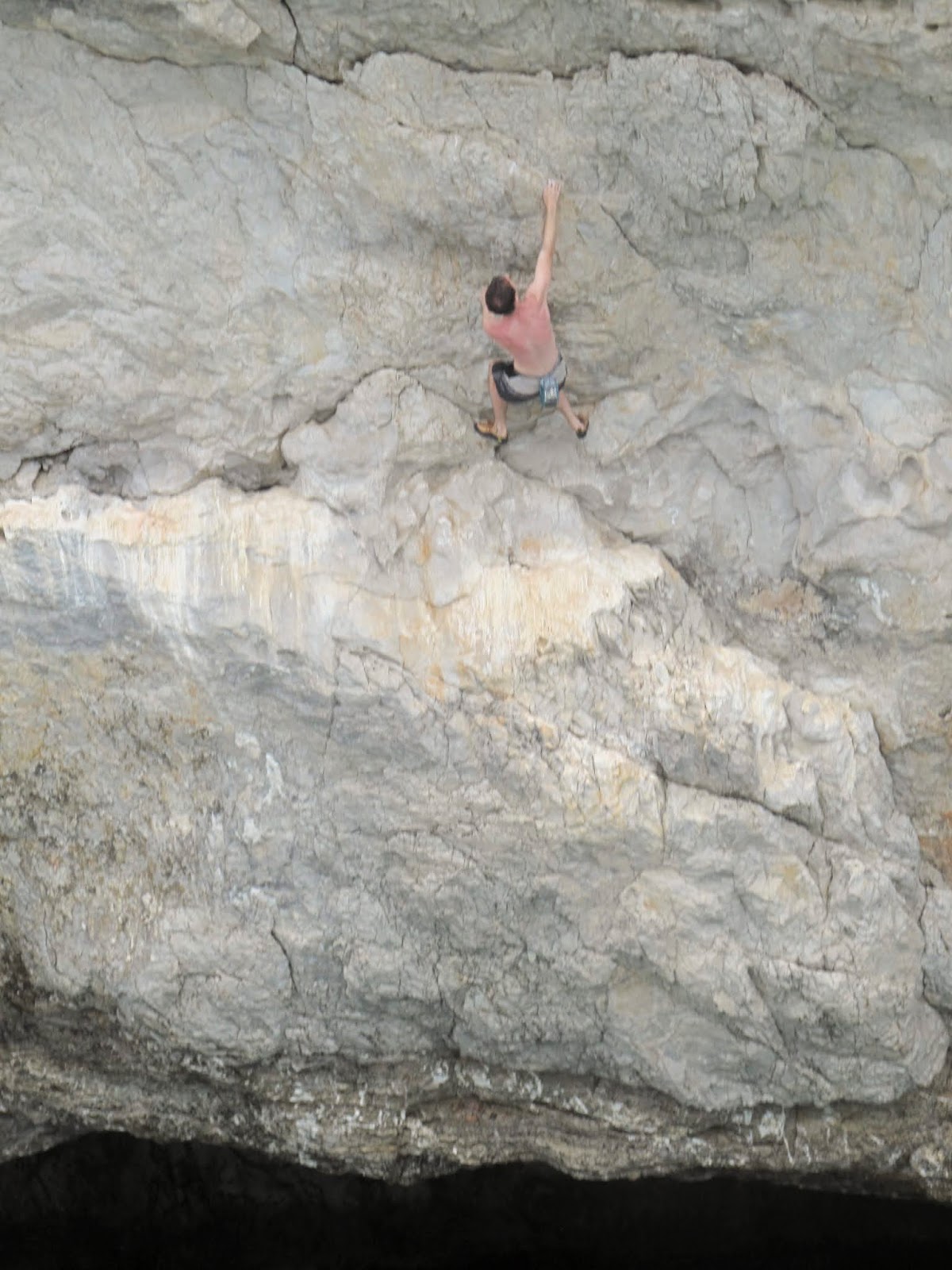
Unexpectedly, when I touched rock I felt good, especially on the first crux in the middle of the route where I had often fallen. I had only got above there twice before. I took my time at the heelhook rest before launching into the upper crux. On the two previous occasions I had got there, I had failed where you have your right hand in an OK pocket, back arched out above the sea and are reaching blindly for something in a shallow ramp feature beyond with your left hand. For some reason - luck? intuition? stronger core? - on this attempt I managed to search around with my left hand a little longer and found a positive sidepull. Instantly my optimism soared - I knew the route could be possible. I threw my left foot up onto the ramp and came through with my right hand to a good gaston hold. From there it was just a glory road of rattly jugs to the sun-baked low terrain rock above the cave.
When I had got my breath back I yelled down to my friends in the boat: "I am giving up climbing now; it doesn't get any better than this". Obviously I didn't but if there was ever a "quit while you are ahead" moment for me, that was it. A DWS send at your grade limit is pretty special.
 |
Gen-X - opening moves © Alan C
Note the Mythos shoes |
 |
| Gen-X, first crux © Alan C |
 |
Gen-X, main crux © Alan C
Possibly my all-time favourite photo - thanks again Alan |
 |
| Gen-X, final moves © Alan C |
 |
| Gen-X, unstylish descent © Alan C |
Subsequent ascents
I have not been back on Generation-X. I did manage two more days on the coast before leaving the UAE, adding a few more new routes. On the second of these days we visited Gen's Cave again, where I was interested in trying one of the big routes on the Gogarth East feature. I climbed The Fixer, 6b, maybe 25m high. I had intended to jump from the finishing ledge but lost my nerve. I started down-climbing then had a change of heart and threw myself off spontaneously before I could re-consider. This was an error. The longer than usual flight time confused me and I entered the water with a pronounced forward lean. When I surfaced, I realised that I could not swim and had to yell to the guys in the boat to haul me out. Back in Abu Dhabi I realised that I had probably broken a rib. I could not climb for another month and by then DWS season was over. A month later I had left the region.
 |
| Me on The Fixer, Gogarth East, Gen's Cave, 2012 |
Musandam climbing got a little more fashionable over the next few years. Oddly the Brits' visit was not the main catalyst, despite articles by Neil and Mikey in two climbing magazines.
In 2013 an all-star North Face/ National Geographic sponsored team (Honnold, Findlay, Chin, Ozturk, etc) explored the coast in a fancy catamaran rented in Muscat. In their social media updates they claimed to be the first to climb on the coast, which irritated a few of us who had pioneered climbing in the region. However I emailed the team a copy of my DWS PDF guide. Their original intent had been to climb big walls above the sea, a bad idea (choss!) from which they could have been dissuaded had they done some prior research. They quietly switched their focus to DWS and Alex Honnold repeated Read's 8a. Mark Synott, the leader of the trip, called me in Squamish on their return to the US, and made a sort-of apology/ thank you. In return, I proof-read the eventual Nat Geo article, which put the record straight and mentioned my guidebook. Hazel also sent me a short account of the
routes that they established.
 |
| so hot right now #1: some dude called Alex, unknown spot, Musandam, 2013 |
A few years after that, Read organised a Red Bull Psicobloc event on the coast, focused on Gen's Cave. The legendary Chris Sharma attended. Unsurprisingly he repeated Generation-X (as well as establishing other lines that went undocumented). As far as I know this was the fifth ascent, which makes me smile ... as the ascent list therefore runs: Gresham; Emmett; Macadam; me; Sharma. I don't envisage that happening again in my lifetime!
 |
| so hot right now #2: some dude called Sharma, Gen-X fifth (?) ascent, 2017 |